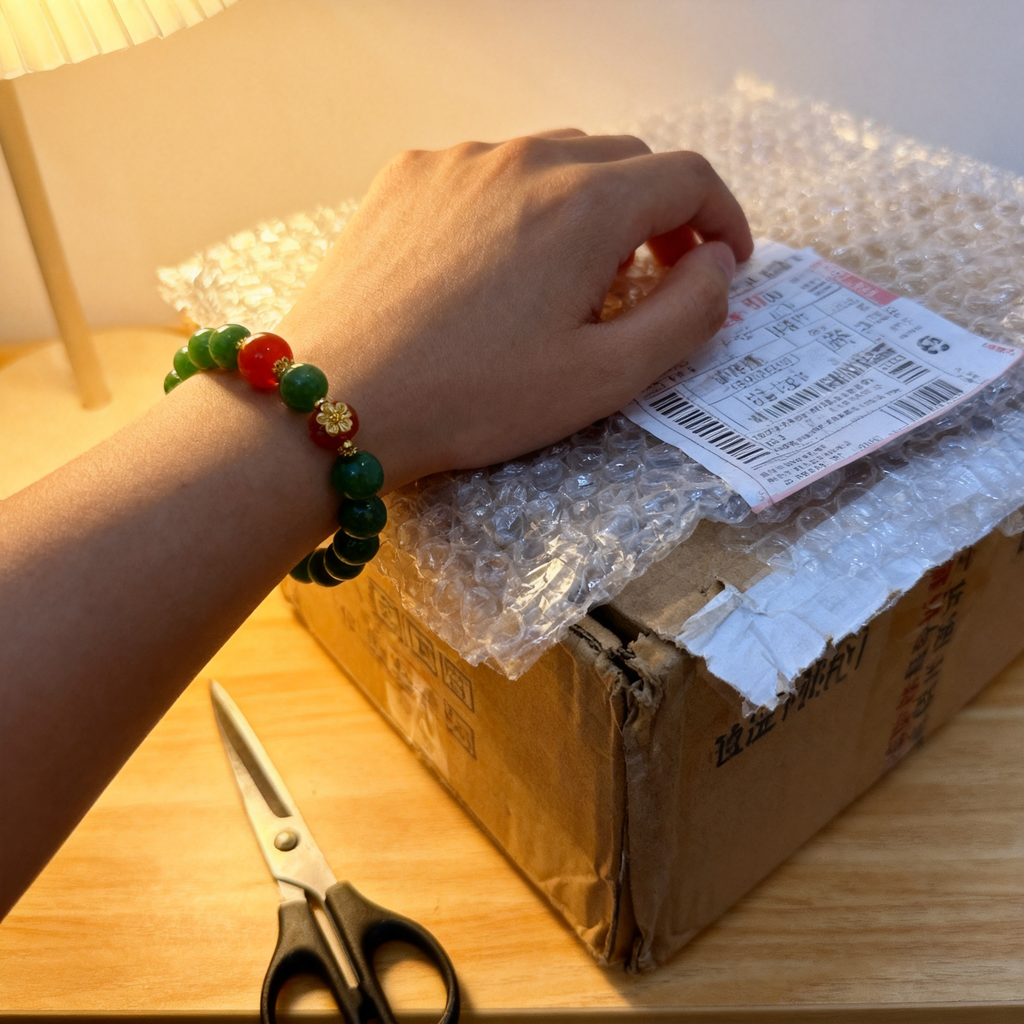
Few stones carry as much history as jade. For thousands of years, across China and beyond, it has been the most treasured of stones — carved into ornaments, worn as protection, and passed down through families. If you are wondering what a jade bracelet means, the short answer is harmony, good fortune, and protection. As with every stone, we will tell you that tradition honestly — and, because jade is one of the most faked and treated stones on the market, we will be especially plain about how to know what you are actually buying.
What is jade?
'Jade' is really two different minerals that look alike: nephrite and jadeite. Both are tough, fine-grained stones that take a smooth, almost soapy polish. Nephrite is the classic Chinese jade — the soft greens, creams, and greys of Hetian and other historic sources. Jadeite is rarer and harder, and includes the vivid emerald 'imperial' green that commands the highest prices.
Jade is unusually tough — not especially hard, but extraordinarily resistant to breaking, because its crystals interlock like felt. That toughness is why it could be carved so finely in antiquity without shattering, and why jade bangles have survived for centuries.
What a jade bracelet means
In Chinese tradition, jade is the stone of harmony, virtue, and good fortune. It has long been associated with balance, moral character, and protection — a stone worn close to guard the wearer and bring steady luck. A jade bangle given within a family carries particular meaning, often passed from mother to daughter.
Beyond China, jade turns up as a treasured stone in many cultures, usually tied to similar ideas: calm, prosperity, and protection. We share all of this as deep cultural tradition, not as fact — jade does not bring luck or guard anyone, but few stones carry a richer history of meaning. For the bigger picture, see our guide to what crystal bracelets mean.
Jade bracelet benefits, honestly
Search jade bracelet benefits and what people usually want is what it is kept close for.
Traditionally, it is worn as a quiet piece of good fortune and harmony — a stone of heritage and steadiness, often with real sentimental weight when it is a gift or an heirloom. The honest version is that the bracelet does not bring luck or balance to your life; it is a real, ancient, deeply meaningful stone, and a wrist to carry it on. For many people the heritage is the benefit — a tangible link to family and tradition.
The one thing to know before buying: A, B, and C jade
This matters more for jade than for almost any stone we write about, so read it before you buy anywhere.
In the trade, jadeite is graded by treatment:
- Type A — natural jadeite, untreated except for a traditional wax polish. This is 'real' jade in the sense most people mean.
- Type B — jade that has been bleached with acid to remove impurities, then impregnated with polymer resin to fill the gaps. It looks better than it is, and the resin degrades over time.
- Type C — jade that has been dyed to improve or fake its colour.
B and C jade are still jadeite mineral, but they have been heavily altered, and they are worth a fraction of natural Type A. Much of the cheap, vividly green 'jade' sold online is B or C. A reputable seller states the type. If a bright emerald jade bangle is suspiciously cheap, assume it is treated.
Jade vs the stones sold as jade
Beyond treatment, many stones are sold as jade that are not jade at all: serpentine ('new jade'), aventurine, dyed quartz, and green glass among them. Genuine jade feels cool, dense, and slightly heavy for its size, and gives a clear, ringing tone when gently tapped — duller in glass or softer stones. Because telling these apart by eye is genuinely hard, buying from a seller who names the material plainly matters more with jade than with almost anything else. Where our pieces use a specific jade such as Hetian nephrite, we say so.
How to wear and care for jade
There is no rule for which wrist, though in tradition jade is often simply worn daily and close, the longer the better. A smooth jade bangle or beaded strand reads calm and classic, and its soft greens pair easily with warm metals and neutral clothing.
Jade is tough but still benefits from care. Keep it off harsh chemicals, acids, and prolonged heat, which can harm treated pieces especially. Wipe it with a soft, slightly damp cloth, and avoid dropping a bangle onto hard tile — toughness resists breaking, but a sharp blow on an edge can still chip it.
Who tends to reach for jade
Jade draws people for two reasons above all: heritage and calm. For many of Chinese and wider East Asian background, it is the stone of family and tradition — often a first serious piece of jewellery, a gift at a milestone, or an heirloom worn for years. Others simply love its quiet, soft-green character: understated, classic, and unlike the sparkle of most crystals. If you want a stone with real cultural depth and a calm, timeless look, jade is in a category of its own.
The Yoshiko view
We will tell you jade has, for thousands of years, meant harmony, fortune, and protection — it is one of the most meaningful stones in human history. We will not tell you it will bring you luck or guard you; that was never the stone's to promise, however deeply people have wished it.
What we will promise is honesty about what a piece actually is — natural stone, named plainly, not treated jade sold as something rarer. In a stone this faked, that matters more than any claim. See how jade sits beside our other stones in the crystal guide.