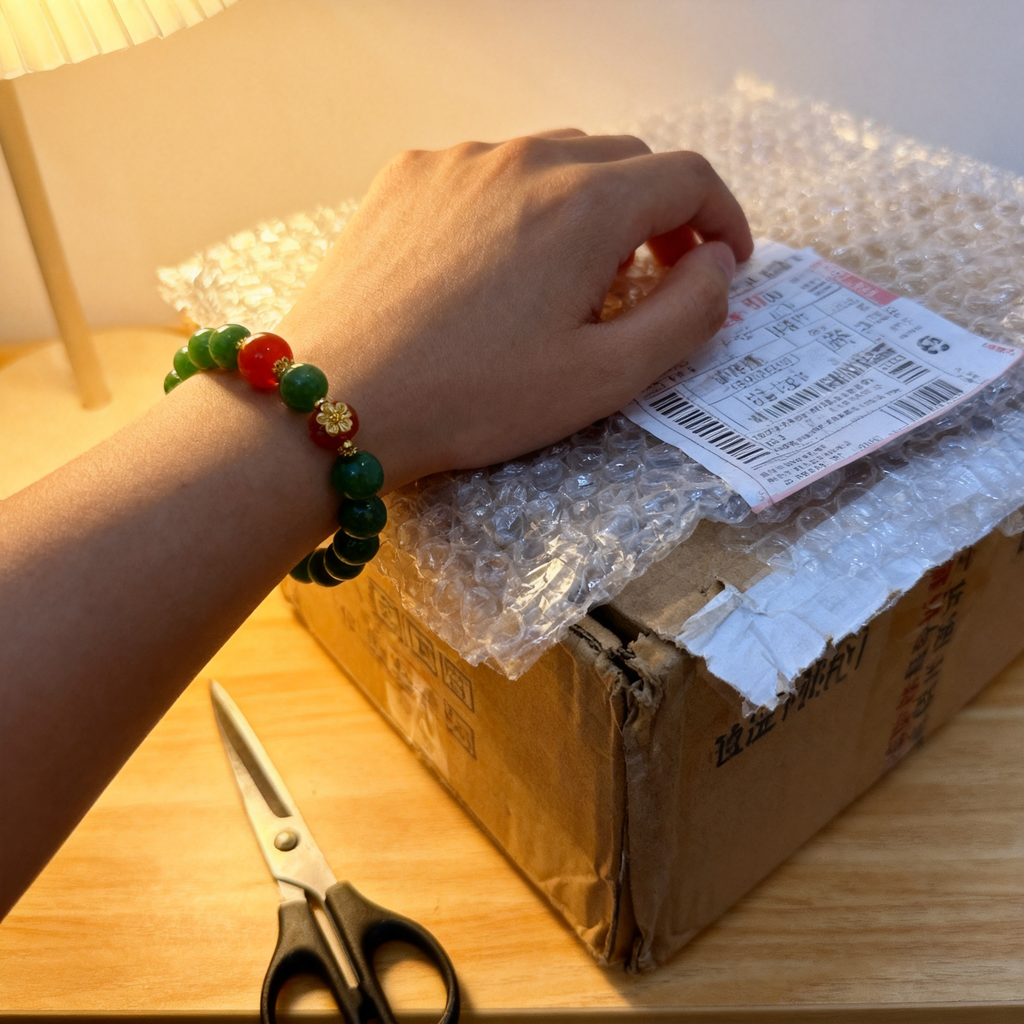
'Natural stone' gets printed on a lot of product pages, but it is worth knowing what it actually means — because in the bracelet world, plenty of 'crystal' pieces are not natural stone at all. This guide explains the difference, how to spot it, and why, for us, it is the whole point.
What 'natural stone' actually means
A natural stone is exactly that: a mineral that formed in the earth over a very long time, cut and polished into beads but otherwise left as it came. Its colour, its markings, and its small flaws are all products of geology, not a factory.
That is different from three other things you will find sold as 'crystal bracelets,' and the differences matter.
Natural, synthetic, and imitation
- Natural stone. Formed in the ground, then simply cut and polished. Amethyst, tiger's eye, black tourmaline, rose quartz — the stones we work with. Each bead is a little different because the earth doesn't repeat itself.
- Synthetic (lab-created). Real chemistry, grown in a lab — the same mineral composition as the natural version, but made by people, quickly and uniformly. Not a scam if disclosed, but not the same as a stone that took millions of years.
- Imitation. Glass, plastic, or resin dyed to look like a stone. This is the one to watch for: it isn't the mineral at all, just something coloured to resemble it.
The honest label tells you which you are buying. The trouble is that many sellers blur the line — which is why knowing the tells is worth your time.
Why variation is the proof
Here is the counter-intuitive part: with natural stone, the imperfections are the quality mark.
Because each bead is a real slice of the earth, you will see the colour shift from bead to bead, faint internal veils or clouds, a line running through one and not the next. Mass-made glass and plastic don't do that — they are too even, too clean, too identical. So when a 'crystal' bracelet looks utterly uniform, bead for bead, with no character inside the stones at all, that consistency is a warning sign, not a mark of quality.
For how the meanings attached to these stones work, see our guide to what crystal bracelets mean.
How to spot real natural stone
No single test is definitive, but a few tendencies stack up:
- Temperature. Natural stone feels cool at first touch and warms slowly. Glass warms faster; plastic feels warm and light from the start.
- Weight. Real stone has a certain density — plastic imitations feel conspicuously light.
- Variation. Look for uneven colour and natural inclusions, as above.
- Bubbles. Round trapped bubbles inside a clear bead mean glass, not quartz.
- Price. If a 'rare stone' bracelet is extremely cheap, treat that as information.
Common fakes to watch for
A few substitutes come up again and again. Dyed howlite is sold as turquoise — turquoise is porous and costly, so cheap, vividly even 'turquoise' is often dyed howlite or magnesite. Glass 'cat's-eye,' a manufactured fibre-optic glass, is passed off as tiger's eye; the tell is a single, too-clean band of light that looks identical on every bead. Dyed agate turns up in unnaturally bright, candy-like colours that agate never occurs in naturally. And 'reconstituted' stone — real stone ground up and glued back together with resin — is sold as solid stone. None of these are the real mineral, and a suspiciously low price is usually the first clue.
An honest word on treatments
Not every altered stone is a fake, and it would be misleading to say so. Many natural stones are routinely treated — heated to bring out colour, as with most red tiger's eye and much citrine, or, less ideally, dyed. A heated stone is still natural stone; a dyed one is natural stone with added colour. Neither is wrong on its own. What matters is disclosure: a seller should tell you, so you can judge the price and the piece. Where a stone of ours has been treated, we say so.
Does it matter for you?
Whether natural versus synthetic matters is honestly up to you. If you want a stone purely for its colour on your wrist, a lab-created or even a glass bead may be all you need, and there is no shame in that. But if part of the appeal is holding something real — a piece of the earth with its own history and its own small imperfections — then it has to be natural stone, because that is the one thing a factory cannot reproduce. We are firmly in the second camp, which is why we only work with the real thing. Just know which you are paying for.
Why natural stone costs a little more
There is a reason a real natural-stone bracelet rarely competes on price with a dyed-glass one, and it is worth understanding. Natural stone has to be mined, sorted, cut, and matched — and because no two beads are identical, someone has to choose beads that sit well together on a strand. Glass and resin are poured into moulds by the thousand, identical and cheap. So when you pay a little more for natural stone, you are paying for the material and the matching, not a markup. It is the same reason a solid-wood table costs more than a printed-laminate one: the material is the value.
The Yoshiko view
Every Yoshiko Crystal bracelet is made from natural stone, hand-knotted in small batches, and left to look like what it is. We won't tell you the stone has powers. We will tell you it is real — formed in the earth, not a factory — and that its quiet imperfections are the proof. Browse the natural stone collection, or explore the rest of our crystal bracelets.