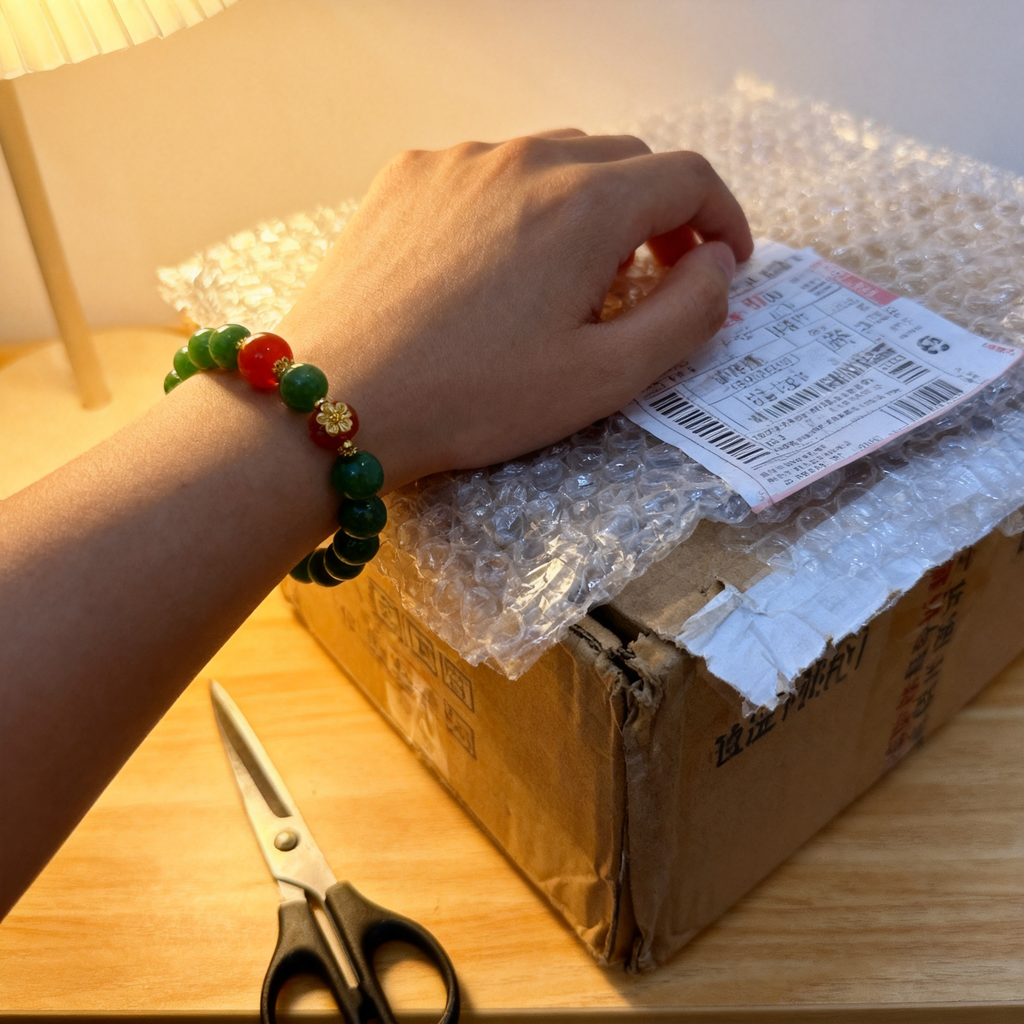
If you are here, one probably just broke — a snapped cord, a scatter of beads, maybe a cracked stone — and you are wondering whether it means something.
There are two honest answers, and we will give you both. One is what people in crystal culture say a break means. The other is what physically made it happen. We will not dress the second up as the first.
What people say it means
In crystal folklore, a broken bracelet is usually read as a good sign rather than a bad one. The most common interpretations go like this:
- It "did its job." The idea that a stone reached the end of a cycle and released what it was holding.
- A protection stone "took the hit." With grounding stones like black tourmaline or obsidian, a break is sometimes taken to mean the bracelet absorbed something on your behalf.
- A chapter closed. A break read as a marker — an intention fulfilled, or a phase you have moved past.
These are traditions, not facts, and we share them the way we share any stone's meaning: as something people have long believed, not as something we can promise is true. If holding one of these readings helps you mark a moment, there is nothing wrong with that. A meaning you choose can be worth keeping.
Our honest take
Here is where we are plain with you. We do not think your bracelet is a talisman that sacrificed itself for you. A broken cord is a broken cord.
That is not us being cold about it. It is the same stance we take on every stone: we will tell you what something has long meant, and we will not sell you a story as if it were a fact. The relief in the honest version is that it is usually fixable. A break is rarely an omen and almost always a repair.
So the more useful question is not what does it mean — it is why did it break, and what do I do now.
Why crystal bracelets actually break
Most breaks come down to a handful of ordinary causes.
Elastic wears out. This is the big one. Stretch cord has a real lifespan — often a year or two of regular wear — and it degrades faster with sweat, lotion, heat, and sunlight. It usually fails at the worst moment, stretched wide over your hand, because that is when it is under the most strain. If a bracelet "keeps breaking," tired elastic is almost always why.
Knotted cord abrades. Hand-knotted bracelets last longer, but the cord still wears where it rubs against rough surfaces, desk edges, or a watch.
Water, soap, and heat. Repeated hot showers and soap weaken cord over time, which is its own subject worth reading on before you wear a bracelet into the bathroom.
Impact cracks stone. A drop onto tile can chip or split a bead, especially in stones that are brittle or have natural cleavage. The cord can be fine while a single stone is the casualty.
Catching and yanking. Snagging a bracelet on a door handle or pulling it off in a hurry puts a sharp load on one point — enough to part a cord that still had life in it.
Thin construction. On cheaply strung pieces with no knots between beads, one break sends the whole strand across the floor. Knotting between beads is what keeps a break contained.
Which stones chip and break more easily
It helps to know that hardness and toughness are not the same thing. Hardness is how well a stone resists scratching; toughness is how well it resists breaking. A stone can be hard and still shatter.
Tougher, more forgiving stones include the quartz family — clear quartz, rose quartz, amethyst — along with tiger's eye, agate, and jasper, whose tightly packed structure makes them hard to break.
More fragile stones, prone to chipping or splitting along internal planes, include fluorite, selenite, calcite, kunzite, and malachite. Obsidian is hard but brittle, and chips at sharp edges. None of these are bad choices — they just ask for a little more care, and a softer place to land.
What to do when it breaks
First, gather the beads. All of them, including any that rolled. A complete strand is simple to rebuild; a missing bead means matching one later.
Then, in almost every case, restring it. Elastic can be replaced; a knotted cord can be redone, and knotting is the more durable choice if you have the option. If a single stone cracked, that one bead can usually be swapped without touching the rest. The point is that a broken bracelet is raw material, not rubbish — there is rarely a reason to throw one out.
If you do feel moved to mark the break in some way, some people like to set a broken protection stone aside rather than rewear it. That is a personal ritual, not a rule, and entirely up to you.
Making a bracelet last
Most breaks are preventable with small habits. Take a bracelet off for showers, sleep, and workouts. Store it flat rather than coiled tight in a box. Roll it over your hand gently instead of dragging it. And if a piece is on elastic, plan to re-knot or replace the cord every year or so, before it fails on its own. Treated this way, a well-made bracelet keeps going for a long time.
The Yoshiko view
We knot our bracelets so that if one ever does break, the damage stays contained and the piece can come back — not scatter and end up in a bin.
A broken bracelet is not an omen. It is an object that wore out, the way real, worn things eventually do. That is not a flaw in it; it is the proof that you actually wore it. Gather the beads, bring it back to life, and keep going.